Heavy cruiser, flat streets, no hills. What a motor fixes and what it costs you
A hub motor solves the cruiser's real weaknesses at low speed, but it adds weight to a bike that was already awkward to lift, and that trade has a price.
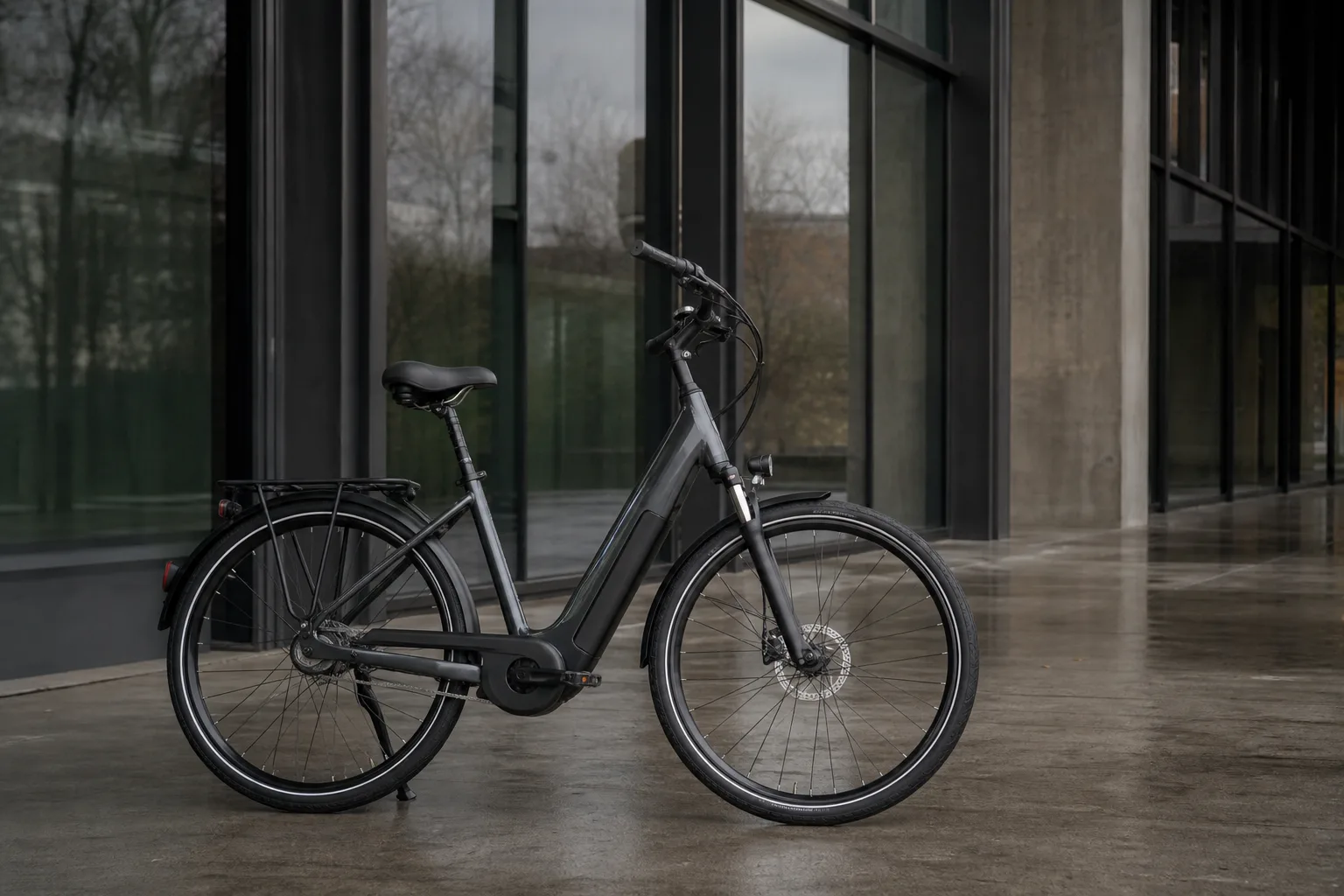
- Weight at the ends of a ride
- Forty-five pounds barely registers while rolling at ten miles an hour on level pavement. It registers heavily at a dead stop, on a staircase, or lifting onto a car rack.
- Long wheelbase, steady tracking
- The stretched frame that makes a cruiser hold a line without input is also what makes it slow to turn in tight spaces. Bike room and garage clearance are worth measuring before purchase.
- Hub motor at cruiser speeds
- A rear hub in the 250 to 500 watt range is working well inside its comfort zone on flat ground at nine or ten miles an hour. That is why these builds tend to be durable in flat towns and marginal in hilly ones.
A cruiser is built around a riding position, not a speed. The bars sweep back so your hands land near your hips, the saddle sits wide and sprung, the wheelbase runs long enough that the bike tracks straight with barely any input, and the frame is steel because steel is cheap, quiet and forgiving. All of that is deliberate, and all of it works. It also produces a bicycle that weighs somewhere in the mid-forties before a battery goes anywhere near it, sits you upright into the wind, and gives your legs almost no leverage the moment the road tilts.
What the shape costs you before any motor is involved
Compare the cruiser with a flat-bar hybrid of the same price and the differences are not subtle. On the hybrid you are pitched forward maybe fifteen degrees, which lets you drive the pedals with body weight rather than quadriceps alone, and the shorter wheelbase makes the bike turn on a thought. The cruiser gives up both. Upright, you push straight down with your legs and nothing else, so a modest rise that a hybrid rider climbs while still talking becomes a standing, wobbling effort on a cruiser. Add a headwind and the same problem appears on level ground.
The weight matters in a narrower way than people expect. On flat pavement at nine or ten miles an hour, forty-five pounds is close to irrelevant, because you are fighting air and rolling resistance, not gravity. The weight shows up at the two ends of the ride: getting the bike moving from a dead stop at a light, and getting the bike anywhere it cannot be ridden. A basement stair, a car rack, an apartment elevator with a narrow door. Those are the moments a cruiser makes you pay for its comfort.
What assist genuinely fixes
A rear hub motor addresses the first list precisely. Starts from rest stop being a chore, because the motor supplies torque at exactly the moment your upright position supplies least. Short rises flatten out. Headwind stops deciding the route. The riding position that was a liability against air resistance becomes a straightforward comfort, because the motor absorbs the penalty and you keep the view. On flat ground at cruiser speeds, a modest 250 to 500 watt hub with a 48-volt battery is not straining, which is why an electric beach cruiser bike can run a whole season on components that would be marginal on a bike expected to climb.
There is a second, quieter fix. Cruisers encourage slow riding, and slow riding on a heavy bike is unstable in traffic, where you need a burst of speed to clear an intersection or get out of a door zone. Assist gives you that burst without standing on the pedals and without changing your posture. The bike stays composed. For a rider who chose upright bars because of a back, a shoulder or a neck that does not tolerate a forward lean, that combination is the whole argument.
What it makes worse, in dollars and in effort
Assist does nothing about lifting, and it makes lifting harder. A battery, a motor in the rear hub and the heavier wheel build around it typically push a mid-forties frame into the high fifties or above, with the added mass split between the very back of the bike and wherever the battery mounts. Carrying that up a flight of stairs is not the same job as carrying a hybrid. Before you buy, walk the actual path from where the bike will live to where it will be ridden, and be honest about it, because a removable battery buys back several pounds and a rack rated for that weight costs real money.
The rest of the cost is maintenance arithmetic. Heavier bike, higher average speed, same brakes: pads wear faster and the case for hydraulic discs over mechanical ones gets stronger. Tires wear faster too. A rear flat now means dealing with a motor cable and a torque washer, which is a fifteen-minute job the first time and a five-minute job after that, but it is not the roadside patch you were used to. The Consumer Product Safety Commission is responsible for the federal requirements that govern bicycles sold in the United States, including low-speed electric ones, and reputable sellers build to them; the parts that actually vary between bikes at this price are brakes, wheels and the battery.
Who should be looking at a different bike
If you live at the top of a hill, or a third-floor walk-up, or you plan to put the bike on the back of a car most weekends, the cruiser shape is fighting you and the motor only settles half the fight. A lighter aluminum step-through with the same low standover and slightly less swept bars gives up some plushness and returns ten or twelve pounds. A folder gives up more and returns the trunk of the car. And a rider whose actual terrain includes sustained grades wants a mid-drive that can use the gears, not a hub motor pushing a single ratio.
For flat streets, short trips, and a rider who wants to sit up and look around, the cruiser plus a hub motor is the arrangement that keeps every good thing about the shape and pays for it once, in weight you mostly only feel when the bike is not moving.
- The start-from-stop problem Getting a heavy upright bike moving from a red light is the single hardest thing its rider does. Assist supplies torque at precisely that moment, which is most of what people notice in the first week.
- Headwind as terrain An upright rider presents a large frontal area, so wind functions like a hill that never ends. A motor turns a route that was weather-dependent into one that is not.
- Total weight after conversion Motor, battery and the heavier rear wheel build usually push a mid-forties frame into the high fifties or beyond. Almost all of the added mass sits at the rear axle and wherever the battery mounts.